Average Reviews:

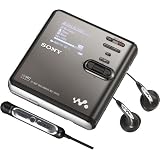
(More customer reviews)This is Sony's top-of-the-line consumer Hi-MD recorder/player. A similar device, a little cheaper, is the MZ-RH910, for which I have posted a long review. There are four differences between the cheaper MZ-RH910 and this model: the display, a remote control, a better battery, and a pouch. The display on this unit is beautiful. The stock images from Sony don't do it justice, so I took a picture of it and uploaded it onto Amazon (hover over the "customer image" thumbnails and click to see it). In my review for the RH-MZ910, I stated that this display was "probably more convenient." I understated the case; this display is much better, allowing you to easily see the display under subdued light or even in total darkness. The only place where the LCD on the RH-MZ910 is superior would be outdoors, where all the light washes out the RH-MZ10 Electro Luminescent display. The RH-MZ10 can be configured so that the display stays on all the time, or the factory setting is that it shuts off most of the display after a few seconds of no buttons being pressed to conserve battery power. The second difference between the RH-MZ910 and is that this unit has a wired remote control. You plug it into the headphone jack and plug your headphones into the remote control. I have not found it to be useful, it easier just to press the buttons on the unit itself. This unit is supplied with a battery that has about 40% more capacity than the MZ-RH910-- although it has the same form factor and it is interchangeable.Finally, this unit is supplied with a pouch big enough to hold the unit and earbuds.
I bought my other unit, the MZ-RH910, for its recording capabilities -- with an analog microphone, that unit and this one can record in uncompressed CD quality (44100 Hz 16 bit Stereo), as Sony calls it "a recording studio in the palm of you hand." To my knowledge, there are no other devices in this price range that can do this, except other Sony minidisc units. Sony has just (August 2005) released some "professional" models which include a microphone (the Hi-MD MZ-M100 is the analogous model). With the MZ-RH10 unit, you need a microphone to record -- I use the Sony ECM-719 -- about $65 -- which I believe is a better mic than the one included with the MZ-M100, both in quality and because it can also be used on non-Minidisc units.
I am very pleased with the quality of the recordings; and other people are usually quite impressed too.Minidiscs are also commonly used to record musical performances, either for practice, demos or to record concerts, though I don't use it for this. These units are also popular with journalists to record interviews. I use it, however, primarily to record the voices of my family and friends. Most people have their memories recorded in photographs and video, but audio is overlooked. However, voice recordings, especially good quality audio, invokes strong emotional responses and memories. Video, even with the highest quality equipment costing thousands of dollars, cannot substitute for it because when people are being videotaped, they become self-conscious and behave differently. The situations where you can shoot video are also much more limited--good lighting, your friends want to look good and be well dressed, etc. You can lay this machine down on the table and record, for example, your parents telling stories or your children, and get candid, authentic, high quality recordings that will sound the same in 20 years as they did the day you recorded them. The next step up from Hi-MD recorders is something like the MAudio Microtrack 24/96 which can record at better than CD quality, and has an impressive feature list, about $400 street price plus more $$ for a 1GB CompactFlash card - I don't know about it's reliability or ruggedness.
After I bought my other unit, the MZ-RH910, I realized I really liked the music-playing capabilities as well -- I must have been the last person in the developed world without an iPod or other digital music player -- and I now needed 2 units since my wife wanted a music player as well. So I researched digital music players. Many of the hard-disc units are very nice, but there was one thing I really disliked about them. Almost all the major brands, the newest units from Apple iPod, iRiver, and Cowon iAudio all had non-replaceable batteries. If this doesn't bother you, then you should probably consider one of these units. However, I really dislike the idea that in a year or two I'll have to send my unit to have the battery replaced, at significant expense, or buy a new unit. Also, I like to be able to load another battery immediately -- this unit also includes a side mounted AA battery holder, a great feature -- basically you will always have power for this unit if you have a spare gumstick battery or some AA batteries. The batteries for the minidisc can be had very cheaply, the Sanyo HF-A1U, a high capacity battery, can be found online for about $8, plus another $6-$8 for shipping. The hard-disk players I did find that had replaceable batteries all seemed to have reliability problems (Rio), or had other limitations -- such as the inability to play uncompressed audio natively (Sony NW-HD5 Network Walkman -- which I might have bought had it not been for this issue). Another advantage of the Sony minidisc units, is that I believe they are less delicate than hard disc units -- for example, my MZ-RH910 was dropped from a counter about 3 1/2 feet high and its perfectly fine. Also, these units have never skipped on me. One disadvantage compared to hard disc units is that minidiscs transfer speeds are not quite as fast -- so it takes a few more minutes to load a CD. This device will load and play back constant or variable bit rate MP3 --but only the MPEG1 codec, not MPEG2 or 2.5. Almost all music will be MPEG1, but speech is sometimes recorded at the lower frequencies available in MPEG2.There is no convenient workaround either, since you cannot force Sonicstage to convert the files to another format -- though you can convert them one file at time in Sonicstage. The Sonicstage software used to transfer files to machine is cumbersome, especially if you are doing frequent transfers.Because of the lack of support for MPEG2 and the cumbersome nature of Sonicstage this device is not recommended for podcasts.The new Sonicstage 3.2 software, released in August 2005, which you may need to download from connect.com, will now encode mp3s from your CDs (at fixed bit rates only) -- though the version I received on the CD, 3.0, would not. You can load the music uncompressed though you will only be able to get 94 minutes on one minidisc -- but the fidelity is really stunning, and if you have good headphones you may want to use uncompressed for your favorite music. It's too bad the player doesn't support FLAC or another lossless format, which cuts the file size nearly in half.
Of course, with a Hi-MD player, you can't really put your whole music collection on one disc. I use the ATRAC3Plus 256 kbps format, which is the larger, higher quality format, it reduces the original uncompressed audio to about 20% of the original size. With this format, I have found you can get about 8 CDs on one minidisc. I have compared this ATRAC3Plus format to MP3s I made using LAME using the 320 kbps compression "insane" setting (the maximum quality and minimal compression permitted). The ATRAC3Plus sounds truer than the MP3 to the original uncompressed version, but you need good headphones to tell the difference. If you use the ATRAC3Plus 64kbps format (if you are using cheap earbuds, you may not notice the difference), you can get about 32 CDs on one minidisc. Additional Hi-MD minidiscs are about $7 each + shipping (Amazon charges a fortune to ship them for some reason, but you can buy them elsewhere). This unit and the MZ-RH910 are plastic instead of aluminum or magnesium, so they don't look as quite as pretty. Magnesium would probably have been nice, but I think plastic is better than aluminum which gets dinged too easily, and portable device like this is likely to be dropped a few times.
In summary: as a recording device, it is without equal for the price and size; as a music player you may want to consider it depending on your priorities.
Click Here to see more reviews about: Sony MZ-RH10 Hi-MD Walkman Digital Music Player/Recorder
Product Description:
Sony has created a great, compact digital music player with the MZ-RH10 Hi-MD Walkman Digital Music Player. Music is stored on Hi-MD discs -- one GB of storage equals over 600 songs (depending on file format). You can easily expand your music storage with additional discs. They are available for only a few dollars, so increasing your storage capacity is affordable. The MZ-RH10 Hi-MD is also backward compatible with the standard MiniDisc media discs.
This player features a unique, six-line EL (organic electroluminescence) display. The attractive EL display makes it easy to see and navigate through title, track, and artist information, allowing you to adjust sound settings with ease. The bright display allows easy viewing in all conditions -- day or night. This recorder also comes equipped with Skip-Free G-Protection technology which provides virtually uninterrupted playback of your music. Music on the go has never been better!
Sony had the digital music lover in mind when they built this digital player. It is highly compatible with your PC. With the included software you can transfer files from your PC to the MZ-RH10, and vice versa, at a break-neck, 100x transfer speed. And while you're doing this you won't have to worry about your digital music player's battery life -- the USB cable will power the unit when transferring music. Speaking of battery life, you can expect up to 33 hours of continuous playback with included nickel-metal hydride rechargeable battery.
If you already have extensive music libraries, use the included software to store and play back your collection of MP3s. On the other hand, if you're just getting into digital music and downloading, Sony's ATRAC format provides higher sound quality with smaller sizes than many competing formats. This enables you to store more music and have longer listening times. The system also allows you to play back the most popular Internet audio formats, including WMA and WAV files, with quick, easy conversion to ATRAC.
Sony just keeps on bringing you the hits with this device. Another great feature is the self-recording upload function. Use the line-in jack on the Hi-MD player to transfer and archive your favorite, old tapes to low cost Hi-MD discs. The mic input is a perfect solution for self-recordings, school concerts, or meetings. With your music or recordings stored on Hi-MD discs, you can transfer the files to your computer and covert them to WAV format. A file saved in WAV format provides you with the flexibility to import the file into a music burning software program where you can burn the file to a CD-R/RW. The MZ-RH10 from Sony is not only a digital music player, but also a mini-recording studio in the palm of your hand. You can capture and digitize almost any sound or old-school recorded format with the mic input and line-in jack!
What's in the Box
MZ-RH10 Hi-MD Walkman, nickel-metal hydride rechargeable battery, charging stand, dry battery case, AC power adaptor, digital cable, Walkman earbuds, SonicStage software, one GB Hi-MD disc, and USB cable.

Want to read more honest consumer review about Sony MZ-RH10 Hi-MD Walkman Digital Music Player/Recorder now ?

No comments:
Post a Comment